Qualify before you commit
Data review, field survey, well qualification, baseline design and a value hypothesis. Fixed fee, credited against a pilot where appropriate, to remove weak candidates before any equipment commitment.

The portfolio runs from the equipment installed at the wellhead to the evidence package handed back to the operator. Each layer has a defined scope and a defined commercial deliverable.
The company is Ecominas Corp. (ECOC), the physical configuration is SIP-3, the analytics and control layer is SIP-AI, and the broader concept is the System of Integrated Production (SIP).
| Layer | Definition | Commercial deliverable |
|---|---|---|
| SIP-3 field package | Annular and tubing backpressure-control hardware, actuators, pressure and other relevant sensors, local controller, communications equipment, fail-safe components and installation materials. | Engineered bill of materials, site survey, installation, commissioning, spares, warranty and maintenance. |
| SIP-AI | Well-specific analytics that evaluate operating data and recommend or execute approved pressure adjustments within defined limits. | Software license or subscription, model configuration, monitoring, alerts, reporting, updates and audit log. |
| Control-room service | Human oversight, exception handling, operator reporting, and approved model or configuration changes. | Managed operations fee, service-level agreement, incident response and performance review. |
| Pilot program | A fixed-scope field evaluation on qualified wells with pre-agreed evidence and safety gates. | Pilot fee, baseline study, installation, controlled test, final technical and economic report, and conversion proposal. |
The initial customer is an operator or joint venture with producing wells that use compatible artificial-lift configurations and exhibit measurable gas interference, unstable pump performance, repeated shutdown and restart behaviour, energy variability or high intervention cost.
Wells with gas lift, packers, incompatible completions, inadequate well integrity, insufficient instrumentation or unresolved HSE conditions may be out of scope. Eligibility is determined by an approved engineering review, never by a generic sales rule.
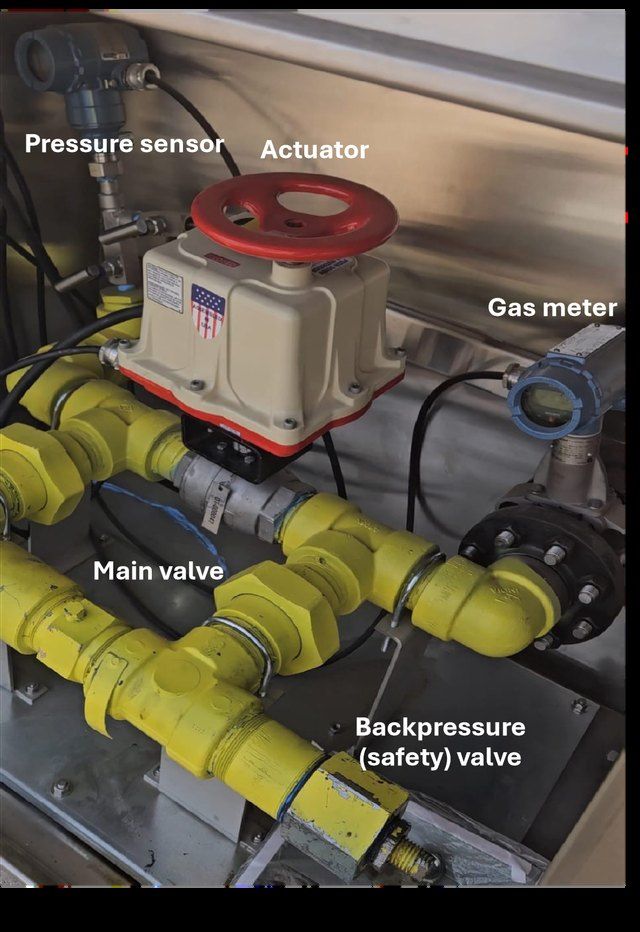 SIP regulator assembly · company source material
The value case connects a single technical mechanism to each stakeholder’s own proof standard , without promising that every outcome will occur on every well.
| Stakeholder | Primary concern | Proof that matters |
|---|---|---|
| Production engineering | Stable fluid delivery, gas behaviour, drawdown and incremental production | Well-level pressure, rate, fluid level, pump-intake and operating-state analysis |
| Artificial-lift team | Pump loading, temperature, vibration, starts and stops, gas lock and run life | Equipment history, event logs, energy signature and failure-mode comparison |
| Operations | Installation burden, alarm handling, override, uptime and field-service response | Method statement, commissioning checklist, alarm matrix, support model and recovery time |
| HSE and integrity | Pressure limits, containment, hazardous-area suitability, fail-safe state and management of change | Hazard review, certification file, proof testing, relief and isolation design, signed operating envelope |
| IT/OT and cybersecurity | Connectivity, identity, segmentation, encryption, patching, logging and incident response | Architecture, asset inventory, access model, test evidence, backup and recovery plan |
| Finance and procurement | Total installed cost, recurring fee, measured benefit, warranty and liability | Reproducible unit economics, pricing schedule, contract terms and insurance |
| Executive sponsor | Scalable production and reliability improvement with controlled downside | Pilot scorecard, portfolio opportunity, compliance clearance and phased deployment plan |
Each offer has its own scope, its own pricing logic and an explicit conversion objective.
Data review, field survey, well qualification, baseline design and a value hypothesis. Fixed fee, credited against a pilot where appropriate, to remove weak candidates before any equipment commitment.
Hardware, installation, commissioning, monitoring, the agreed test and the final report. Fixed pilot fee, with an optional verified-performance component under a defined cap.
Standardized site package, SIP-AI subscription, control-room service, reporting and maintenance. Installation plus a recurring per-well fee, with fleet pricing at defined volume.
Portfolio screening, staged rollout, integrations, governance and performance reviews. Platform fee plus per-well or outcome-based components.
The first objective is not geographic coverage. It is a repeatable reference case built with a small number of operators who have a meaningful population of technically eligible wells, an accountable executive sponsor and the authority to run a measured pilot.
Qualify the operator, the transaction and the wells for legal, technical, HSE, data and economic fit.
Complete a paid diagnostic and identify a pilot population with an agreed baseline.
Execute a pilot agreement governing installation, data, IP, liability, access, cybersecurity, publication and removal.
Install and commission under approved management-of-change and permit-to-work procedures.
Run the test, preserve an immutable data record and issue the agreed weekly reports.
Produce a joint technical and economic report, including limitations and exception wells.
Offer a staged multi-well rollout with explicit capacity, service-level and commercial terms.
Review portfolio performance quarterly, and renew or expand only where value remains verified.
Scaled delivery requires standardized equipment, qualified suppliers, spares, calibrated instrumentation, trained installers, field-service coverage and disciplined configuration management.
| Capability | Minimum control |
|---|---|
| Engineering | Approved drawings, design basis, materials and pressure ratings, software configuration and change control |
| Procurement | Qualified-vendor list, sanctions and ownership screening, origin and export classification, quality clauses and traceability |
| Assembly and testing | Incoming inspection, calibration, factory acceptance test, serial-number record and nonconformance process |
| Field installation | Site survey, job safety analysis, permit to work, pressure isolation, proof test, commissioning checklist and operator acceptance |
| Remote operations | Shift coverage, alarm priority, escalation, override authority, incident response, maintenance window and disaster recovery |
| Service | Spares policy, response-time tiers, preventive maintenance, field replacement, returns and warranty reserve |
| Performance reporting | Version-controlled calculations, operator-approved data, exceptions and audit-ready output |
Tell us about the field, the lift type and the behaviour you are seeing. The first step is a paid diagnostic, not a commitment.